Wednesday, May 22, 2013

First Excursions on Palmyra


            While I’m jealous I didn’t get to be the one to yell “Land Ho,” I’m happy to be the one to share with you all about our first landfall and first excursions away from the ship.
            Last night, as we sat anchored in front of Cooper Island, bungalows and satellite dish in view, the antsy-ness was palpable. Walter wanted to run, Soda wanted to swim, and many others wanted their Wifi connection. After a good night’s sleep, we woke up to a rainbow over Penguin Spit, a popular project and snorkel site, shining a good omen for the day. And a good day it was.
            For those studying island-based projects, progress was made. Zack, Laura, and Erin laid six coral transects, Jason secured his hydrophone and is currently recording acoustic soundscapes of the reef, and John saw eleven manta in one day – the number of rays he hoped to see for the entirety of his project. On the ship, Frido processed blood, Anja caught up on pteropod swirls, and others continued to stand watch to ensure safety and security of the vessel. As for me and a few others, ahead on project work, taking a break from project work, or pretending we didn’t have project work at all – we went ashore. 
            Being ashore was surreal. I took a dip in the swimming hole, admired crab on North Beach, and after much inner conflict about whether or not I wanted to stay off the grid (because really, it’s only been eleven days), I indulged myself in a few minutes of email catch up. First of all, the swimming hole is the image of paradise. The weather is warm, the water is clear, and palm trees are rampant. Then, there was North Beach – a place where every pretty seashell was inhabited by crab, the sand lively with crustacean traffic.
However, even a paradise in the middle of nowhere still feels the long reaching fingers of civilization thousands of miles away. Washed ashore, we found plastic bottles – the kind I’m sure many of us have enjoyed a cold drink from on a hot summer day or served soda out of at birthday parties and barbecues. Thankfully though, the disruption in landscape was minimal. We only found and properly stowed six or so bottles, letting the sand caress our toes all the while.
           Not many people get to experience the beauty of Palmyra Atoll, but I hope that my blog and those written by others in the following days adequately share with you the splendor surrounding us as well as the importance of Palmyra’s presence. Once a naval base during World War II, transformed into a wildlife refuge since, Palmyra may be the closest example of a pristine coral reef ecosystem left on the planet. I’m excited to be here. Tomorrow, weather permitting, I will snorkel for the first time and I will see my first coral reef. Beacons of climate change, I’m excited to finally see the subject matter I’ve learned about in many a lecture. Wish me luck.

Penguin Spit awaits,
-Christina Morrisett


Team Manta

The ventral side of manta 11 (nicknamed “Manta V” because of its distinctive markings).

            Today was day 1 of Team Manta, and what a day it was. In total, we saw 11 manta rays. We were able to deploy acoustic tags on three of those rays and got video footage of 6 of them. Making all this manta spotting happen requires quite the production. We deployed in the ship’s rescue boat with a team of five: our chief scientist, our expert tagger TA, our bosun who piloted the boat, and two students. Once we arrived at the channel, all eyes turn to the water where every dark shape looks like a manta. To get an underwater view, we take turns hanging on to the side of the boat while snorkeling. Onboard, we have acoustic tags and GoPro cameras at the ready.
            “MANTA!” the shout goes up and we spring into action. GoPros start rolling, tags are passed over the side and everyone dives for the manta. We only have a few split seconds before the ray will disappear again into the murky waters. Confusion and coughing up seawater are common occurrences, but by the end of long hours of motoring back and forth along the channel, we had been wildly more successful than I had imagined we possibly could be on our very first day.
            Tomorrow, we will deploy acoustic receivers that detect the specific frequency emitted by the tags we deployed today. This will give us real-time data about manta movements through the channel. All of the mantas we observed today appeared to be transiting out of the channel, so I am especially curious about when the mantas enter the lagoon. We also plan to deploy more acoustic tags and continue to photograph the ventral (underside) of the manta. Like a whale’s tail, a manta’s ventral spots are individual to each ray so capturing footage of the bottom of mantas is helping researchers around the world to identify the mantas they see.
            We head out again bright and early tomorrow and then will have a few more manta spotting sessions before we depart Palmyra on Friday evening. Check out the pictures below for some stills from today’s Team Manta deployment!

            Cheers,
           -John


Walter Torres from Palmyra

Palmyra Atoll is paradise. Offshore of Palmyra, wave crests break violently over the coral reef surrounding the island. These corals protect Palmyra’s serene inner lagoon by dissipating the furious energies of ocean waves and tides. This outer coral reef separates the unforgiving cobalt sea from the tranquil turquoise waters welcoming those entering the lagoon. Tall coconut trees loom out of the dense forest and cast dancing flowery shadows over white sand. Entering Palmyra Atoll was truly unforgettable.
            Now what? It turns out that science must press on and maintaining the ship doesn’t stop when the anchor hits the sea floor. We are still organized in watch squads that collectively are responsible for ship duties 24 hours of every day. Even in paradise we remain “eternally vigilant” as Captain Pamela Coughlin constantly urges us to do. We conduct half-hourly radar and anchor checks to make sure we remain in a fixed location and we strive to keep the boat in top condition. As assistant scientist Mitch Schrimpf says,”On the ship, cleanliness IS godliness”. The crew of the boat stays busy repairing the boat, updating and organizing nautical charts, and unloading the huge load of supplies we brought to the Palmyra station (this makes me think our voyage is a glorified UPS service). Our scientists toil away at the delicate chemistry involved in processing phosphate and nitrate samples gathered from our hydrocasts. As students, we are responsible for assisting our scientists and crew with these tasks on top of helping our wonderful cook Sayzie in the galley with preparing food.
            When not occupied with watch though, we have some truly awesome opportunities to explore Palmyra. Our crew operates small craft that take us on outings to land or snorkeling spots each morning and afternoon. Some of us help out with other student projects in the reef environment and some of us just go out for recreation. People have told tales of the awesome megafauna spotted in the reef including blacktip sharks, manta rays, and huge snappers (that if caught on rod and reel would be all-tackle world records according to our resident IGFA representative Martini. However The Nature Conservancy owns and protects Palmyra so no sport or commercial fishing is allowed). Land expeditions have also been thrilling and full of discovery. I went on one land expedition that witnessed one of the most bizarre animal interactions I have ever seen.
            Eels occupy nooks in the shallow reef environment and are generally ambush predators. Eels have small fins on a flexible undulating body, which aerodynamically and physiologically limits their proficiency at hunting in open water. Instead, eels coil up and blend in with the sand and coral and wait to devour unsuspecting prey swimming by. Or so we thought.
            The north shore of Palmyra is as ideal as a postcard and is only marred by ruins left by the U.S. naval base from World War II over which hordes of crabs now scuttle frantically. Our land expedition was passing one of these old navy bunkers when Nicole suddenly yelped and pointed at a 3-foot spotted moray eel slithering out of the water and onto the beach snaking its way directly for her. However the eel paid no mind to Nicole and instead lunged for an oblivious ghost crab catching some sun and seized it between its jaws. The eel proceeded to tie itself in a half hitch and used the torque to audibly crack the crab’s shell, sealing its fate. The eel then widened its jaws and swallowed the crab whole all on the white sand under the hot tropical sun. It then casually slithered back over the sand into the shallows without even glancing at the four of us documenting this remarkable event. Holy shit that was cool.


-Walter Torres

Rambling On with Lucas Oswald


I’m going to be rambling on for a little bit here, so don’t mind me! It’s something I’ve gotten quite good at here while sailing the seven seas, except this is a unique and rather sane opportunity for my ramblin’ as I actually have an audience. Normally, my ramblin’ takes place in the wee hours of the night under the star spangled midnight sky. I can always count on a good conversation with myself to keep myself wide-awake, alert to what may come on that horizon, and in good spirits!
And anyway, sometimes its not ramblin’ as much as just singing. I may have just not had a good opportunity to try it out before this, but as it turns out, singing is a fantastic way to entertain yourself while clipped into the bow of the ship on the long midnight look outs. Whether I’m squealing out in a disgraceful replication of Robert Plant,
“Hey-hey Mama, I said the way you move,
“Gonna make you SWEAT,
“Gonna make you GROOOOOVE!” soon followed by a copious amount of “Wah-wah-wah’s!” and “Duh-nuh-nuh’s!”
As if I weren’t already sweating enough out here. Or perhaps during my more desperate and shameless moments, wailing out to Neptune with a voice crackly,
“What if GOD was ONE OF USSSSSS!
“Just a FOOL like ONE OF USSSSSS!”
These episodes usually last as long as it takes for one of the daily miracles of life, beauty, or science to emerge and distract me from my singing, as they do frequently. Like, for instance, noticing that out in some special spots of the Pacific, stars shine not only from above but also from below, with bursts of neon bioluminescence trying as hard as they can to mirror the sprawling Milky Way from the depths. Or maybe that daily phenomenon is a new and mysterious creature pulled up from the blackness beneath us, now blobbing about indifferently in a jar of formalin.
Anyway, now for the important stuff. As part of our Marine Conservation class, we are each giving what we call  an Uncommon Dialogue, a talk hosted by the students on the deck of the ship as we traverse the worlds largest ocean. My own Uncommon Dialogue, however, will take place with you, our family and friends back home, as I will be reporting on the talks we have with occasional blog posts.
On our way down to Palmyra Atoll (a unbelievable place that certainly merits a later blog post of its own), our very own Evan Clark started us out with a fascinating talk about conservation from a planetary perspective.
Evan told us about one moment during the Apollo 9 space mission, during which an astronaut was given the opportunity to observe earth from afar for 5 minutes while he was alone, floating in space. During this time, the astronaut realized that the planet he was seeing beneath him was nothing less than a perfectly sustainable space ship, possibly the most successful one in existence. With this in mind, conservation is not only a social and scientific movement but also the maintenance of our very own global life support.
Evan then posed as interesting question. We as conservationists feel the responsibility to care for the life on our planet, but would we have that same responsibility to care for life if it were discovered on another planet? And what do the answers to this question tell us about our role as the stewards of life here on earth? How far do our responsibilities extend, and what gives us those responsibilities? After all, as Evan told us, it was a single photograph of the earth rising over the surface of the moon from afar that began the green movement.
Following Evan, Caroline Ferguson started us off on a conversation about the farming and manipulating of marine organisms, which spun quickly into a class wide debate on the potential, and also the limits, of aquaculture.
From the perspective of feeding the planet, aquaculture is a great accomplishment for the human race. But, as Caroline reminded us, the situation is not so simple. Aquaculture entails the confinement of fish to a small and usually enclosed area in contrast to the vast oceans they are evolved for and used to. The result is in an unhealthy buildup of byproducts and waste that pollute our waters to a dangerous degree. And the problems do not end there. Aquaculture comes hand in hand with selective breeding, where fish are chosen for their abilities to mature quickly, grow large, and also develop at a favorable feed to size ratio. What this means is that we are fundamentally changing the species we grow, and all this is aside from the so-called “Franken-Fish,” which are explicitly genetically modified salmon that are awaiting USDA approval.
So the question remains, how far can we take aquaculture? As more and more selectively bred fish escape into the wild each year, competing with the already depleted wild stocks and also potentially muddling their gene pool with unnaturally selected traits, the problem is growing exponentially and may soon get out of hand.
As we sail, each week will bring about a new round of uncommon dialogues, which I will do my best to summarize and bring to you via our blog here at sea. This is Lucas Oswald signing off, and until our next report, be sure keep an ear to the wind. Who knows, you may just hear me singing us down to Christmas Island. 
-Lucas Oswald

Tuesday, May 21, 2013

Nicole's Arrival at Palmyra


This afternoon we sailed into Palmyra Atoll. At around 1500h, our standing bow-watch, Lucas, yelled ‘Land Ho!’ with excitement upon discerning the silhouette of the island. Standing on the tip of the bow, a group of us then gathered with binoculars to confirm that we did in fact see land ahead. We were subsequently guided into the magical atoll by flocks of gracious sea birds, and welcomed by energetic dolphins leaping in the water off the starboard side.

As we approached the pristine atoll, we began to see individual trees and several islets, surrounded by multi-tonal turquoise water, lush green vegetation, and wispy skies painting a picture with colors of brightness so high they cannot be captured through a camera lens. Students and staff swarmed to the forward deck to witness this moment, and for the quietest period of time I’ve ever experienced on the deck of the Robert C. Seamans, there was complete silence as we all gazed in awe at the surreal image forming in front of us. Palmyra had us all in a trance, a fixation that was only broken by the rush of students to the portside quarterdeck, where someone announced a sighting of manta rays as we were anchoring in front of the marine research station.

Approaching Palmyra was like entering a wild virgin land of a different era. We felt like true explorers encountering what seemed like a mirage in the middle of the Pacific after ten days of purely open seas.

This thirst for exploration is a unifying theme in our diverse group. In one way or another, we are all driven by a powerful curiosity to understand the world around us. Through scientific pursuits, and through individual reflection. This innate yearning for discovery is what brings people out to sea in the first place. We are participating in a fascinating marine research excursion and engaging in a riveting sailing adventure, but we are also on a transcendental journey of deep personal growth and life re-evaluation. Altering the baseline of reality has forced us to discover our truest self, unhindered by society, standards, work, or school – just the ship and the open ocean.

While the sea has helped us discover ourselves, we’ve also been discovering the complexities of the sea throughout our expedition. Students on the trip are all pursuing independent research projects to answer innovative questions about marine biology and oceanography, aiming to explain an aspect of the ocean they’re fervently passionate about. Guided by world-class scientists whose pursuits have also been driven by this same unquenchable desire for exploration, we’ve been exposed to different ways of viewing discovery. Discovery can involve evaluating a phenomenon through a different lens, finding out something completely new, encountering an unnamed species, or synthesizing data and attempting to make sense of the wonders of nature. We are mesmerized by the magnificence of our planet and use science to decipher its beautiful intricacies. Charles Darwin made his greatest discoveries regarding speciation on the voyage of the HMS Beagle when he was about 22-years-old.  There is something remarkable about this period in our lives, where vitality, open-mindedness, and the curiosity of youth perfectly merge with intellectual development, critical thought, and scientific exploration. Everyone on this ship exhibits this insatiable curiosity and I know great things are to come.

For me, arriving at Palmyra felt like I was on the brink of discovery, I was discovering a mystical new place and about to begin my exciting research project on coral reefs, where I’ll be delving into the largely unexplored field of coral disease ecology and trying to figure out how coral disease might be transmitted and propagated. Hopefully I’ll discover something new and shed some light on disease dynamics through my studies in this magnificent atoll just waiting to be explored. I am excited for all the discoveries we’ll make on our voyage, and am thrilled to continue this adventure with such a phenomenal group of young explorers!

-Nicole Rodriguez

Arrival at Palmyra


The Seamans closes in on Palmyra
Robert Seamans has arrived at Palmyra and the first leg has ended after 1000 nm- the weather is perfect, the scenery is grand and we're all looking forward to coral reef observing and exploring this island in paradise.

-Dr. Barbara Block

Sunday, May 19, 2013

Rob Carrera on the end of the Fist Leg


                As we leave the oxygen minimum zone behind us and the frenzy of hydrocasts and net tows along with it, everyone is looking ahead to Palmyra, which we should be greeting with a LAND HOY! sometime tomorrow evening. But today was also a time to look back on the southern open ocean leg of our voyage.
                We’ve been on the Seamans for nine days and have been sailing for eight, and we’ve come almost a thousand miles. Most of us came aboard knowing nothing about sailing, especially sailing on a tall ship. I think most of us, when we first looked up at the mess of lines and canvas that we were soon supposed to be able to operate by ourselves, had an “oh shit, there’s no way” kind of moment.
                Since then, we’ve not only learned all the sails and lines, but we’ve learned how to be efficient and (for the most part) punctual crewmembers (real deck monkeys), even when we need to be on deck and ready at 3am. We’ve also done a lot of science. Every one of us has classified hundreds of zooplankton, dragged the five hundred pound carousel out on deck and operated the winch that lowers it six hundred meters down into the ocean, found the biovolume of our net tows, and used our spectrophotometer to find the pH of our water samples. Martini and Robby caught a sailfish, a spearfish, a wahoo, and a skipjack tuna, from which we drew blood samples for Frido’s project (and the last two made excellent sashimi). Alessandra’s been busy dissecting these big catches, and we’ve captured lots of smaller but still awesome creatures, like salps, nudibranchs, and a weird, transparent fish with a black center that our professors couldn’t identify, and which may be a new species.
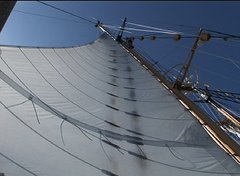
                Today, knowing that we were past most of the science deployments, was one of the most relaxed days I’ve had so far. Some of the crew played their ukuleles and sang the Weight, Wagon Wheel and, just for kicks, Puff the Magic Dragon. Some people hung up their laundry and just chilled on deck. I stood bow watch and got some pretty nice pictures of our full stack of sails (course, topsail, and raffee), which we set for the first time today. It was definitely a good way to end this first oceanic portion of the trip.
                 The past week has been full of hard work, sleep deprivation, and general craziness, but it is most definitely a week that we can be proud of. Tomorrow, we’ll arrive at Palmyra a little saltier and with some very real experience under our sailorly belts. Even better, we can expect a whole new set of experiences after landfall that will be just as alien (at least for me) as the past week on the Seamans.
-Rob Carrera