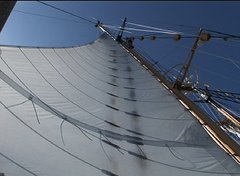
Sunday at sea. After about 3½ days at anchor, we left Nuku Hiva around 1730 yesterday, and while everyone was sad to say goodbye to the magical island, I think we were all ready to go to sea again. During the night, we set our course for 355ºPSC, set sails, and shut off the main engine! Nothing like the trade winds to carry us to Hawai’i.
Some highlights from our 3 days in port:
-On Wednesday, we had an epic hike through the lush tropical vegetation to a waterfall that Captain Phil knew about. Considering the seemingly limitless surrounding vertical walls, isolated nature of the pools, and the coolness of the water, it’s no wonder that there was unanimous agreement on the boat that it was the coolest place most of us had ever been in our lives. We closed out our first day in port with a delicious barbeque dinner on deck, some sweet live music, and general merriment enjoyed by all.
-On Thursday, the “off” watches dispersed for a wide array of adventures, including tattoo-seeking, hiking, swimming, hitch-hiking, scuba diving, and pineapple-picking.
-On Thursday, Friday, and Saturday, most people on the boat had a chance to take a tour of the island from a local woman named Jocelyn. She showed us Taipivai valley (the location of and inspiration for Melville’s book Typee), countless breathtaking views, and incredible ancient archaeological ruins tucked away under the tropical canopy.
-On Saturday morning, some of us headed to the market on the wharf at 0530 to buy some fresh produce for the boat. There was a big festival that day, including an outrigger canoe race (average speed was about 10 knots, no big deal) and a dance party that unfortunately happened after we hauled up anchor.
Sunday, May 24, 2009

Wednesday, May 20, 2009
Hard at Work
It’s almost 1700, and the main salon is full of students cramming in their sun line calculations before we reach Nuku Hiva tomorrow. The deck was packed at Local Apparent Noon today as we were all trying to get our sun sights. Those of us not working up our LAN in the sweltering salon or on watch are up in the increasingly-crowded lab prepping for the MIME 4 station. We’re doing not one but two hydrocasts tonight woohoo!!! And a meter net and a neuston tow. That lab is going around the clock, that’s for sure. But we’re getting a ton of awesome data for the Marquesas Island Mass Effect project.
Sunday, May 17, 2009
Wrapping up Work in the Gyre

Student Stacy Aguilera counts fish on deck.
We are headed toward the Marquesas with gentle breezes and warm days. The water temperatures are the hottest we've seen, hovering about 85F, and the air temperatures are getting past the 90s. It is remarkably warm- but we're all staying well hydrated and cool with lots of water freshly made by reverse osmosis.
The ocean waters are oligotrophic -- nutrient-poor and a crystal clear. We're in our last days within the South Pacific Gyre, greeted daily by marvelous sunrises and sunsets. We'lll soon be in the Marquesas where two days of intense sampling are planned to examine the Island Mass Effect- examining howthe islands, like rocks in a stream, create vorticity and upwelling in the wake behind the strong west-flowing currents. This creates hot spots with nutrient-rich waters coming to the surface.
Eugene and Ethan will be leading the stations through this region- we anticipate up to 6 stops to sample the physics, nutrients, and biological life in the water column.
During the transit from Rangaroa to NukaHiva, Natalie Arnoldi caught some skipjack tuna for her project, which focuses on the foraging diet of these warm-water predators.
As we're crossing the water column, the carbon and climate research group - led by Jessica Hinojosa, Mara, Reese and Sam - has been getting super Total CO2 and pH in situ. The data coming in are research-grade, and everyone is excited about the opportunity to make such precise measurements that have a bearing on how oceans impact climate.
Soon we'll be at Nuka Hiva- a high pointof our stay in French Polynesia.
-Dr. Barbara Block
Thursday, May 14, 2009
Science in the South Pacific Gyre

Students furling a small sail aboard the Seamans.
The RCS is in the South Pacific Gyre where we can report very warm waters, oliogtrophic seas and fair breezes, minor squalls and occasionally no wind at all! We're heading toward the Marquesas and Science is in full swing. We daily are collecting CTD casts with Niskin water bottles that are collecting samples for nutrients, chlorophyll and carbon. Nets are going in daily at noon and midnight aswe target the biodiversity of the epipelagic to the mesopelagic. Diverse creatures from pteropods to porpita greet us daily.
We're heading toward Nuka Hiva and the next 3 days will be filled with stations for the Island Mass project that Ethan and Eugene are heading up. In the midst of this oligotrophic, low-productivity sea they hope to identify how and why regions of high productivity occur in association with the Islands. Satellite imagery provided by Dave Foley of NOAA has guided our approach and late tonight we start a series of 5-6 stations to see what exactly occurs in the water column around this area. Fishing has picked up, with animals as diverse as tunas, wahoo and spearfish attacking some of the baits we're towing for sampling the epipelagic.
Spirits are high among our students, and all is well aboard the RCS as we are getting into the rhythm of beingat sea.
Dr. Barbara Block
Tuesday, May 12, 2009
Rangaroa Atoll - which means “Long skies”
Lush green coconut trees, thick vegetation, turquoise waters and crushed coral shores. After coursing through a challenging channel between the Motu Islands of this fantastic and large atoll, we came inside the lagoon to an anchorage overlooking a tranquil scene - a tropical paradise that includes a small town, a few dive shops, a pearl farm and a resort hotel.
We explored the sediments below the ship for a geological project investigating the history of the coral lagoon during the early morning hours. Using our zodiacs we made landfall and took on a variety of shore activities. Snorkel trips took off investigating the reef fish, channel explorations revealed a vast biological diversity inclusive of rays, barracuda, reef fish and sharks. The atoll’s fishers and divers know the sea well here and shared with us the Polynesian’s latest information on the state of their reef.
Missions on small boats to investigate the geology of the lagoon and students studying pelagic fish went off after the rare dogtooth tuna. Fishing on the outside of the atoll we encountered several bait balls rich with frigate birds, boobies and yellowfin tunas. We almost caught the elusive dogtooth as the sun set but lost this large reef predator right at the boat. Perhaps in the Marquesas we’ll get another opportunity. The port stop was short but allowed the students and faculty time to explore a remarkable location in the Tuamotus - the “Sea Islands”.
Dr. Barbara Block
We explored the sediments below the ship for a geological project investigating the history of the coral lagoon during the early morning hours. Using our zodiacs we made landfall and took on a variety of shore activities. Snorkel trips took off investigating the reef fish, channel explorations revealed a vast biological diversity inclusive of rays, barracuda, reef fish and sharks. The atoll’s fishers and divers know the sea well here and shared with us the Polynesian’s latest information on the state of their reef.
Missions on small boats to investigate the geology of the lagoon and students studying pelagic fish went off after the rare dogtooth tuna. Fishing on the outside of the atoll we encountered several bait balls rich with frigate birds, boobies and yellowfin tunas. We almost caught the elusive dogtooth as the sun set but lost this large reef predator right at the boat. Perhaps in the Marquesas we’ll get another opportunity. The port stop was short but allowed the students and faculty time to explore a remarkable location in the Tuamotus - the “Sea Islands”.
Dr. Barbara Block
Sunday, May 10, 2009
The Class Arrives!
The Stanford@SEA class arrived in Papetee Tahiti after many of the students enjoyed a few days of touring the islands of Tahiti and Moorea. We met the RCS (Robert Seamans) at the central dock in a busy downtown and casted off the lines for Moorea a nearby island. Dr. Boris Worm from Dalhousie joined the scientific team of Rob Dunbar, Barb Block and Jan Witting, and together with the captain, crew and students we casted off the lines for our 5 week adventure.
After a delightful short trip from Tahiti across gentle seas we anchored in Cook’s Bay in the center of an ancient volcano. The anchorage was surrounded by lush green, jagged peaks and a tranquil setting for our ship orientations and safety briefings. We gazed at crystal blue waters and a gorgeous sunset set while feasting on a home cooked dinner on deck.

The Robert Seamans anchored in Cook's Bay
The next morning we left in the morning for Rangaroa, the second largest Atoll in the world. Fair breezes from the west made sailing easy and by midday we had most of our lower canvas up. Students are quickly learning the rig of the RCS. Science stations have started and CTD casts (an instrument that measures physical parameters of the water column) and water samples for a variety of projects have been collected. The Class has quickly mastered many instruments as we had a rapid succession of stations collecting microbiology samples from a Long Term Ecological site off Moorea for a project funded in part by the Census of Marine Life (CoML), nutrient and carbon samples from depths along the track and than some net tows into the water column. Dr. Dunbar’s team has successfully installed a sophisticated instrument for sampling total carbon in the surface waters allowing several projects to make some major measurements along our cruise track that will inform the team about the oceans role in the carbon cycle.
It's been a quick and successful start.
Dr. Barbara Block
After a delightful short trip from Tahiti across gentle seas we anchored in Cook’s Bay in the center of an ancient volcano. The anchorage was surrounded by lush green, jagged peaks and a tranquil setting for our ship orientations and safety briefings. We gazed at crystal blue waters and a gorgeous sunset set while feasting on a home cooked dinner on deck.

The Robert Seamans anchored in Cook's Bay
The next morning we left in the morning for Rangaroa, the second largest Atoll in the world. Fair breezes from the west made sailing easy and by midday we had most of our lower canvas up. Students are quickly learning the rig of the RCS. Science stations have started and CTD casts (an instrument that measures physical parameters of the water column) and water samples for a variety of projects have been collected. The Class has quickly mastered many instruments as we had a rapid succession of stations collecting microbiology samples from a Long Term Ecological site off Moorea for a project funded in part by the Census of Marine Life (CoML), nutrient and carbon samples from depths along the track and than some net tows into the water column. Dr. Dunbar’s team has successfully installed a sophisticated instrument for sampling total carbon in the surface waters allowing several projects to make some major measurements along our cruise track that will inform the team about the oceans role in the carbon cycle.
It's been a quick and successful start.
Dr. Barbara Block
Thursday, May 7, 2009
Stanford@SEA to set sail across the Pacific

From Stanford Report, May 1, 2009
BY LOUIS BERGERON
Ask anyone who is a master at their craft, and you'll likely be told there is no substitute for hands-on experience. At some point, you have to get your feet wet if you're going to learn how it's done. Thus, the Stanford@SEA program, which takes students on a five-week voyage on the Pacific Ocean to conduct oceanographic research and heighten their awareness of the vital role the oceans play in supporting life on Earth and regulating the global climate system.
This is how you're going to get the next generation of students thinking about these problems," said Barbara Block, the Charles and Elizabeth Prothro Professor in Marine Sciences at Stanford University, Hopkins Marine Station, and one of the instructors.
The 22 undergraduates and two graduate students assisting in this year's class will fly to Tahiti the first week of May and set sail May 8 from Papeete aboard the oceanographic research vessel Robert C. Seamans. The 134-foot, two-masted brigantine will sail through part of the Society Islands before heading northeast across the Tuamoto Archipelago to the Marquesas Islands. Leaving French Polynesia, the expedition will head northwest, crossing the equator as they sail roughly 3,500 nautical miles of open ocean to Hawaii. The group will be at sea for 37 days.
Along the route, the students will be conducting oceanographic research projects they designed during the on-land half of the course at Hopkins Marine Station, as they studied oceanography, and maritime culture and nautical science, the latter taught by the ship's captain. The steel-hulled ship was built specifically for ocean research and teaching, with laboratory, library, classroom and computer facilities on board. Students' research projects this year will include investigating the role of the equatorial currents in the carbon cycle and how ocean acidity is affecting certain invertebrates.
In addition to research, the students are required to pitch in with operating and maintaining the ship—everything from swabbing the decks to standing watch to navigating and steering the ship itself. Various members of the team also will be blogging as the voyage progresses.
Christopher Hanson, now a junior, went on the voyage in 2007. He and a partner studied populations of large predators in the Line Islands in the central Pacific.
"Stanford@SEA is an incredible experience," Hanson said. One of his strongest memories is of smelling the grass and flowers of the Hawaiian Islands as they appeared on the horizon after the long sea voyage.
"You don't realize what the Earth smells like until you are away from land for weeks at a time and you are surrounded by ocean," he said.
Hanson credits the experience with helping guide him to his major in the Earth Systems Program. "Prior to that voyage, I had never even heard of [that major]," he said. But Rob Dunbar, the W. M. Keck Professor in the School of Earth Sciences and the Victoria P. and Roger W. Sant Director of the Earth Systems Program, was one of the chief scientists on the voyage. Dunbar is teaching and sailing again this year.
"Stanford@SEA is my all-time favorite teaching experience. We are able to focus and observe in ways that are never possible in a normal classroom back at Stanford," Dunbar said. "This class always ends up changing peoples lives … and even though I've been going to sea for more than 40 years I always learn something new that changes how I think about the ocean. I expect this trip will be no different." Block said a lot of students have been guided in their career choices by their time on such voyages.
Bruce Robison is one of many former students who took a similar class in the 1960s, when Stanford was using the converted luxury yacht Te Vega as an ocean-going research vessel, and was influenced.
Robison said that while the ship and program were different when he was a student, the fundamental goal was the same. "Take students to sea and let them conduct research in an environment that in many respects, both literally and virtually, was total immersion," he said. "It was the best thing that ever happened to me."
Robison is now a senior research scientist at the Monterey Bay Aquarium Research Institute in Moss Landing, but back in 1967 he wasn't sure of his direction.
"I was interested, but I didn't really know if I had any aptitude," he said. "One of the things that [a voyage like] this shows you is that oceanography, at any rate as we still practice it, is both physically challenging as well as intellectually challenging.
"When I realized, 'Hey, I can do this and I like it!' that was an important revelation," he said.
"The sea has a special capacity to kindle in many people this very transformative experience where they then move on to a career in ocean sciences," said Block, who herself was influenced in her career choice by taking a similar class as an undergraduate through the Sea Education Association (SEA), in Woods Hole, Mass., which owns and operates the Robert C. Seamans, a ship built with support from private funders as well as the National Science Foundation.
Stanford@SEA is a cooperative venture between the Massachusetts association and Stanford. In addition to Block and Dunbar, a third chief scientist on this year's voyage will be a marine biologist with the Sea Education Association, Jan Witting. Boris Worm, an ecologist from Dalhousie University, also will be on the trip, as will three additional associate scientists and five professional crewmembers.
This is the fourth session of Stanford@SEA, which has been offered alternate years, starting in 2003.
Block sees courses like Stanford@SEA as vital to the planet's future.
"Really what climate is about is how the atmosphere and the ocean are coupled, and if we don't teach this next generation about how these systems work, if we don't attract students to these types of courses and put them in touch with the ocean, I believe that we will not have enough people trained in this fashion in order to generate the type of scientific research we are going to need to pursue the questions we need to solve Earth's problems," she said.
Block and Dunbar are both senior fellows at Stanford's Woods Institute for the Environment.
Subscribe to:
Posts (Atom)